

The world of business is changing fast. Artificial intelligence is not just a new tech trend. It’s changing how we work and the economy itself.
Studies from the World Economic Forum show this big change. AI is expected to create 97 million new jobs, with average salaries of about $160,056. Also, companies using AI are growing their productivity much faster than others.
This shows a key point. The best way for businesses to stay ahead is not to pick between humans and AI. The future is for those who can use both well together.
This partnership, a true human-AI partnership, brings out the best in both. It leads to new ideas, better decisions, and huge efficiency gains. This article will help you understand and use this powerful team-up for better business results.
The Competitive Imperative for Human-AI Collaboration
Before businesses can fully use human-AI collaboration, they must face a harsh truth. The idea of easy, automatic teamwork is not just too good to be true; it’s risky. Leading research shows we need a smarter approach.
“On average, human-AI combinations did not outperform the best AI-only systems and were statistically significantly worse.”
A major MIT study looked at a huge amount of data. It shows a key point: just putting a human and AI together doesn’t always mean better results. In many cases, the combined system underperformed. The idea that AI and human collaboration is always good is not true. It needs careful planning.
The main problem is how well the partnership is set up. Bad collaboration can lead to poor results, often because of how humans interact with the tech. Key issues include:
- Misjudging when to trust or override an AI’s recommendation.
- Experiencing automation bias, where humans defer to the system even when it’s wrong.
- A lack of intuitive interfaces that foster effective, real-time teamwork.
- Insufficient training on both the AI’s capabilities and its limitations.
So, understanding and mastering effective partnership is now a must. It’s not just a theoretical benefit. Companies that ignore this risk wasting money on advanced tech. But those who plan their human-AI workflows well can achieve more than either could alone. The message is clear: move from assumption to intentional design.
Augmented Intelligence: Redefining the Future of Work
Research from places like MIT shows a key difference between basic help and true teamwork between people and AI. This difference is at the heart of a more powerful idea: augmented intelligence.
Augmented intelligence is about using AI tools to boost and support human thinking. It’s not about making machines that work alone. Instead, it’s about making systems where humans and machines work together, with each helping the other.

MIT researchers make a clear split in this area. They talk about human-AI augmentation, where humans and AI together do better than humans alone. The next level is human-AI synergy, where their work together is even better than what either could do on their own.
To reach this top level, we need to rethink how we work. It’s not just about adding AI to human tasks. We need to create new ways of working altogether.
This thinking goes beyond just automating tasks. Augmented intelligence aims to create new, team-based approaches. In these, the human and AI together become more than just the sum of their parts.
So, changing the future of work means seeing things differently. We move from replacing tasks to making them better. By designing for synergy, companies can unlock the true power of human-AI teams.
The Uniquely Human Advantage in Business
AI is great at processing data and spotting patterns. But, it’s humans who bring strategic innovation and leadership to the table. These human strengths are not just “soft skills.” They are essential for turning data into action and creating lasting value.
Strategic Creativity and Conceptual Innovation
AI can spot trends and come up with new ideas. But, it can’t create true conceptual innovation. Humans are amazing at thinking outside the box and imagining new possibilities. This strategic creativity is what drives innovation in business.
It’s about connecting different ideas and challenging the status quo. Humans have a unique ability to think abstractly and look ahead. This is what fuels long-term growth, something AI can’t do on its own.
Emotional Intelligence and Ethical Reasoning
Dealing with complex human relationships and moral dilemmas is a human task. Emotional intelligence is key for building trust and understanding people. It helps us connect with others on a deeper level.
Ethical reasoning involves making decisions based on values and principles. Humans use empathy and moral intuition to ensure technology benefits society. This ensures technology serves humanity’s interests.
Nuanced Communication, Persuasion, and Leadership
Effective communication is more than just sharing information. It’s about understanding the unspoken and adapting our message. Humans are skilled at persuading and inspiring others through their stories.
True leadership is about connecting with people and giving them a sense of purpose. It involves mentoring and making decisions that consider individual circumstances. These are skills AI can’t replicate.
Adaptability in Unstructured Situations
The business world is full of unknowns. Humans show incredible adaptability in these situations. We use our intuition and common sense to navigate uncertainty.
This ability to think on our feet and learn from minimal information is invaluable. It helps organisations adapt and thrive in chaotic environments.
The partnership between human creativity and AI is powerful. Human strengths complement AI’s capabilities. They provide the “why” and the direction that AI helps deliver.
The Formidable Capabilities of Artificial Intelligence
Artificial intelligence (AI) is a powerful tool in today’s business world. It can do things that humans can’t, like processing huge amounts of data quickly and accurately. When combined with human insight, AI gives businesses a big edge over their competitors.
Processing Vast Datasets at Incredible Speed
AI’s main strength is its ability to handle and analyze vast amounts of data fast. While humans might struggle with a million data points, AI can handle billions in the same time. This makes big data a valuable asset for businesses.
This skill is key for real-time analytics and monitoring global markets. It helps businesses make decisions based on complete information, not just samples. Understanding how innovation benefits from AI starts with its ability to manage information at scale.

Identifying Complex Patterns and Predictive Modelling
AI is great at finding hidden connections in data that humans might miss. It uses advanced machine learning to build models that predict trends and customer behaviour. This helps businesses make smarter decisions.
This skill is used for everything from personalized product recommendations to predictive maintenance. It turns historical data into a tool for future planning. The predictive power of AI helps businesses act proactively, not just reactively.
Unwavering Consistency and Operational Precision
Humans can make mistakes due to fatigue or error. AI, on the other hand, is always consistent. Once trained, it performs tasks perfectly every time, day and night.
This is very useful for tasks that need precision and speed. From checking legal documents to assembling parts, AI ensures quality and efficiency. It handles the hard work, freeing humans for more creative tasks.
Synthesising Insights from Disparate Information Sources
Business challenges often involve data from different sources. AI can link these sources together, combining sales data with social media or research. This gives businesses a complete view of their market.
By combining different data types, AI provides insights that humans might miss. This supports innovation, risk assessment, and finding new opportunities. It helps businesses see beyond traditional data silos.
| AI Capability | Core Business Function | Human Limitation Addressed |
|---|---|---|
| High-Speed Data Processing | Real-time analytics & big data management | Limited speed and volume in manual analysis |
| Complex Pattern Recognition | Predictive forecasting & personalisation | Difficulty identifying non-linear, subtle correlations |
| Operational Consistency | Quality assurance & automated task execution | Performance variance due to fatigue or error |
| Cross-Source Insight Synthesis | Innovation strategy & integrated risk analysis | Challenges in connecting information across separate domains |
In summary, AI’s strengths are not about replacing human thought. They provide tools that excel in managing data, finding patterns, ensuring accuracy, and connecting different sources. When used with human creativity and ethics, AI unlocks its full power.
Why People and AI Make Good Business Partners: The Synergy Effect
When humans and AI work together, they create something greater than they are alone. This partnership is based on a simple idea: each does what the other can’t. The goal is to boost human thinking, not replace it, making a strong collaborative intelligence for shared goals.
This mix of skills changes how we work and boosts performance. Let’s look at what makes this human-AI synergy so effective.
Fueling Creativity with Data-Driven Inspiration
AI is not a creativity killer, but a spark. For tasks that need new ideas, AI’s help is huge. It can come up with lots of ideas fast.
For example, a designer might use AI to get many logo ideas quickly. A marketing team could get lots of headline options for a campaign. This doesn’t take away from human creativity. Instead, it speeds up the idea-making part, giving humans a chance to improve and add their touch.
AI is like the ultimate muse, giving endless ideas for humans to shape into real innovation.
Informing Judgement with Probabilistic Forecasting
Human decisions can be clouded by biases and limited data. AI helps here. It’s great at probabilistic forecasting and finding patterns in big data.
Take a supply chain manager dealing with delays. AI can look at weather, port data, and supplier info to predict problems. The manager uses this info to make smart, strategic choices.
This partnership means decisions are based on solid data and analysis, not just gut feelings.
Elevating Human Focus to Strategic and Creative Tasks
The biggest win of human-AI synergy is freeing up human brainpower. AI takes care of routine tasks, letting humans focus on what they do best.
A financial analyst can now spend more time on analysis and client advice. An engineer can dive into design and solving problems. This move raises the whole team’s game.
AI does the hard work, while humans bring vision and direction. This is where businesses find real value and gain an edge.
The aim is to build a true partnership between humans and AI. It’s about more than tools; it’s about a smart, integrated team.
Quantifying the Partnership: Key Business Benefits
The partnership between humans and AI brings real, measurable benefits to businesses. This powerful team turns possibilities into real results, improving key areas of business. The benefits of AI collaboration are clear, showing how together, humans and machines can achieve more than alone.
Superior, Data-Informed Decision-Making
At the heart of this partnership is better decision-making. AI quickly sorts through huge amounts of data, finding patterns and connections that humans miss. It makes fast, accurate predictions and models different scenarios.
But, data alone is not enough. Human insight is needed to understand the context and ethics behind the data. Leaders use their experience and knowledge to make informed decisions, considering risks and opportunities.
This leads to smarter, more thoughtful decisions. A study on AI in business shows that teams with AI make quicker, more accurate choices. This leads to better results in finance, logistics, and planning.
Dramatic Improvements in Operational Efficiency
AI helps businesses work better by automating routine tasks. This frees up people to do more important work. This change brings big, measurable benefits.
- Cost Reduction: AI automates tasks in customer service, data entry, and inventory, cutting costs and reducing mistakes.
- Predictive Maintenance: In manufacturing, AI predicts when equipment will fail, saving time and money.
- Resource Optimisation: AI optimises supply chains, energy use, and scheduling, reducing waste.
These improvements are not about replacing people. They’re about making work more efficient. Humans oversee these systems, handle exceptions, and improve processes.

Deeply Personalised Customer Engagement
Today’s customers want interactions that feel personal. AI makes this possible by analysing customer data across different channels.
Machines can suggest products and customise messages with great accuracy. But, connecting with customers on an emotional level is a human task. Professionals use AI insights to create empathetic communications and build loyalty.
“The most effective customer strategies use AI to understand the customer at a data level, and humans to connect with them at a human level.”
This approach turns customer service into a key revenue driver. It boosts customer lifetime value and loyalty.
Accelerated Cycles of Research and Development
Innovation is key to staying ahead. Human-AI teams are speeding up the time it takes to bring new ideas to market. AI quickly sorts through research papers and databases to find promising areas.
In pharmaceuticals, AI simulates how molecules interact, speeding up drug discovery. In engineering, AI explores design options, freeing up humans to focus on the best ideas.
The benefits of AI collaboration in R&D are clear. They lead to faster, cheaper innovation. This keeps businesses ahead in fast-changing markets.
In summary, the partnership between humans and AI brings big benefits. From better decisions and more efficient operations to loyal customers and faster innovation, the partnership is a game-changer.
Real-World Synergy: Industry Case Studies
The benefits of working with AI are clear when we look at real-world examples. These AI business examples show how partnerships are tackling big challenges and creating new opportunities.
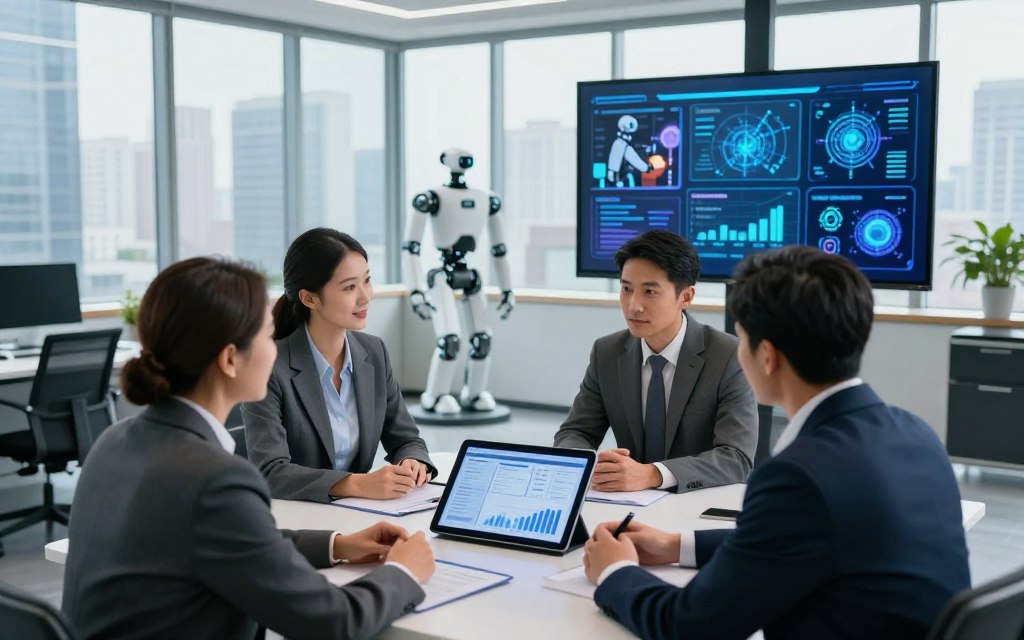
Healthcare: IBM Watson Oncology and Diagnostic AI Assistants
Enhancing diagnostic accuracy and tailoring treatment plans.
In oncology today, AI systems like IBM Watson quickly scan through lots of medical data. They help doctors find the best treatment options for patients.
Doctors use their knowledge and understanding of patients to make the final choice. Diagnostic AI assistants for medical images help spot problems for radiologists. This teamwork leads to care plans that are both precise and caring.
Financial Services: Kensho’s Analytics and Real-Time Fraud Detection
Empowering analysts and securing transactions.
The finance world uses AI for quick risk checks and security. Kensho helps analysts by quickly sorting through market data and news. This lets them focus on making smart investment choices.
AI watches over millions of transactions every second to catch fraud. Humans then check out any suspicious activity. This team effort keeps assets safe and boosts analysis, showing AI’s value in finance.
Manufacturing: Siemens’ Predictive Maintenance and Smart Factories
Minimising downtime and optimising supply chains.
In manufacturing, AI predicts when machines might fail, helping Siemens’ smart factories. This lets maintenance teams act early to avoid downtime.
AI also checks quality by looking at images. Humans then look at the bigger picture, manage production, and keep improving. This makes operations smooth and efficient.
Marketing and Sales: Salesforce Einstein and AI-Powered Content Tools
Personalising customer journeys and analysing campaign sentiment.
AI has changed marketing by making it personal at scale. Salesforce Einstein uses data to predict what customers might do next. This helps sales teams build stronger connections.
AI can even start writing content or check how campaigns are doing. Humans then add their touch, making sure the message is right. This teamwork makes campaigns hit home, showing AI’s power in marketing.
These examples from different industries prove a key point. The best results come from AI and humans working together. Each sector example shows how dividing tasks can lead to better results, from accuracy to innovation.
Building a Collaborative Framework: From Strategy to Implementation
To get the most out of human-AI teamwork, companies need a solid plan. This plan should move from ideas to real action. It helps make sure your effort in implementing human-AI collaboration brings real benefits.
The first step is to look closely at your business processes. Success comes from making workflows better, not just automating tasks. It’s about a team that keeps learning and improving together.
Identifying High-Value Use Cases for Augmentation
Start with specific problems where AI can help a lot. Get a team together to find tasks that are too long, prone to mistakes, or need lots of data. This way, you focus on areas where human-AI teamwork can do better.
Ask important questions like: Where do our experts get overwhelmed with info? Which decisions are made with incomplete data? The goal is to make humans better, not replace them. This approach gets everyone on board and makes the team stronger together.
Selecting and Integrating Fit-for-Purpose AI Solutions
Once you know what you need, look for the right AI tools. Avoid flashy but not useful AI. Look for tools that fit your needs, work with your systems, and give clear insights.
The best technology is invisible; it empowers the user without adding complexity to their workflow.
Integrating AI is both technical and about people. Make sure data moves smoothly and AI results are easy to understand. Start small with a few users to test and get feedback before going big.
Cultivating an Organisational Culture of Human-AI Teaming
Technology needs the right culture to work. Leaders should see AI as a tool to help, not replace. Be open about AI’s role and limits to build trust. Talk about new skills and roles to ease fears.
Encourage trying out AI and sharing its limits. Celebrate when humans and AI work well together. This turns doubts into excitement and makes everyone part of the team.
Designing Intuitive and Effective Collaborative Workflows
The last step is to design how humans and AI will work together every day. This is where process redesign is key. Make sure the workflow is new and works well with AI, not just adds it.
Make sure who does what is clear. What AI does, what it suggests, and when humans decide. Have a way for humans to correct AI and improve it. This makes both better over time.
By following this plan, companies can build a strong partnership between humans and AI. This partnership is productive and keeps getting better.
Upskilling for the Augmented Age: Essential Competencies
Working with AI is not about replacing people but about making them better. The best workers in the future will be those who know how to use AI well. They will be the ones who can direct AI’s power, not just use it.

Companies need to teach their teams new skills. This will help them use AI wisely and make decisions with human insight. There are three main areas where skills are needed.
Developing Critical Data Literacy and Analytical Skills
AI works with data. To use it well, you need to understand data. This means knowing where data comes from and its limits.
Key skills include:
- Interpreting AI Outputs: It’s important to question AI’s answers and understand why it gave them.
- Statistical Reasoning: You need to know about probability and how to trust data insights.
- Contextual Application: Turning data into useful business decisions is a key skill, like using AI in trading.
This skill keeps humans in charge. They use AI to look at data, not make decisions for them.
Mastering Interaction: Prompt Crafting and AI Interface Management
Talking to AI systems is as important as typing. This skill, called prompt engineering, is about making good instructions for AI. It helps get the right answers from AI models.
Being good at this means:
- Precision in Language: Making clear, specific prompts to get the right results from AI.
- Iterative Refinement: Improving prompts based on AI’s answers to get better results.
- Tool Competence: Knowing which AI tools to use for different tasks.
The most powerful AI is useless without a human who can ask it the right question in the right way.
This skill makes AI a tool that humans can control. It turns AI into a partner, not just a machine.
Strengthening Critical Thinking and Ethical Evaluation
Thinking critically about AI is key. It means being careful and ethical. Every AI output needs to be checked for accuracy and fairness.
Improving this skill means focusing on:
- Bias Detection: Finding and fixing AI biases that can harm people or businesses.
- Source Verification: Checking AI content against trusted sources and experts.
- Ethical Reasoning: Making moral decisions based on AI insights, with care for people’s lives and privacy.
This skill is the most important. It ensures we use AI wisely. Investing in these AI skills is essential for progress in the human-AI partnership.
Addressing Practical Challenges and Ethical Imperatives
Creating a strong partnership between humans and AI is tough. It involves solving many problems and making sure AI is fair and trustworthy. We must tackle issues like communication gaps, bias, and data quality to make ethical AI collaboration work.
Mitigating Algorithmic Bias and Ensuring Equity
AI systems learn from old data, which can be biased. If not fixed, they can make things worse in areas like hiring and law enforcement. This is a big problem.
To solve this, we need to check the data AI uses and keep an eye on how it works. Diverse teams help spot problems that others might miss.
True fairness in AI means making systems that help everyone get a fair chance. This is more than just fixing a problem; it’s a key business goal.
Prioritising Transparency and Explainable AI (XAI)
Some AI models are too complex. People need to understand why they make certain decisions. Without clear answers, trust and rules can get complicated.
Explainable AI (XAI) helps us see how models make decisions. For example, an AI that says no to a loan should explain why.
“For AI to be a trusted partner, its reasoning must be interpretable, not just its results impressive.”
Being open about how AI works is essential, not just for its results. This makes AI a clear guide in important areas like healthcare and finance.
Safeguarding Data Privacy and Robust Governance
AI needs lots of data, but keeping personal info safe is key. Bad data handling can lead to big problems. A strong plan for handling data is vital for ethical AI collaboration.
Companies must follow rules like GDPR and CCPA. They should also use privacy-first design. This means collecting less data, keeping it anonymous, and controlling who can access it.
A good AI governance plan includes:
- Tracking data origins and history.
- Regular checks for security and weaknesses.
- Clear rules for who is responsible for AI decisions.
- Groups to review AI projects for ethics.
Managing Workforce Transition and Fostering Adoption
Change can make people worried about losing their jobs. This fear and lack of understanding can cause problems. It’s important to handle this carefully.
Leaders need to explain how AI will help, not replace, jobs. Training should focus on understanding data and working with AI.
To get people on board, make AI easy to use. Show them AI makes their work better. Changing how people see AI is key to success.
Dealing with these issues is an ongoing effort. It’s what makes the partnership between humans and AI in business strong and lasting.
The Evolving Partnership: Trends Shaping the Next Decade
Generative AI is changing how humans and AI work together. It’s moving from a helper to a creative partner. This change is reshaping the future of human-AI work, making AI a real-time co-pilot in solving problems and coming up with new ideas.
Now, AI tools can create drafts, designs, and code frameworks. Humans then improve and add to these ideas. This teamwork speeds up creative work and brings out new ideas that humans and AI couldn’t come up with alone.
AI is becoming a real-time helper in analysis and creativity. Imagine AI helping strategists during meetings or engineers designing prototypes together. This makes AI a key part of decision-making, not just a background tool.
Being able to work seamlessly with AI is key to success. The goal is for AI to feel like an extension of human thinking, part of everyday work tools. Experts say this collaboration has “boundless and poised for exponential growth” possibilities. Companies that get this right will have a big edge in speed and insight.
Several trends will shape the next ten years:
- The Democratisation of Advanced AI: Easy-to-use AI will let non-tech staff use powerful tools for analysis, making content, and planning.
- Context-Aware and Proactive Systems: AI will do more than just respond. It will anticipate needs based on the project, past actions, and current data.
- Ethical and Explainable AI by Design: Trust is key as partnerships grow. New systems will focus on being clear, so users understand AI’s reasoning.
- Continuous, Mutual Learning: The partnership will keep getting better. AI will learn from feedback, and humans will keep learning to use AI better.
This changing world needs a flexible approach from everyone. Success in the future of human-AI work will go to those who see AI as a dynamic team member. It’s about learning new skills in using AI, evaluating its suggestions, and working together.
The next decade will bring a partnership that’s more intuitive, creative, and integrated into all business areas. By embracing these changes, businesses can move from using AI to truly working with it. This will open up new levels of innovation and strategic thinking.
Conclusion
The most powerful business model is not just humans or machines. It’s a mix of both. This mix is called collaborative intelligence.
The future of work needs us to learn new skills. We must know how to work with AI. This way, AI does the routine tasks, and we focus on the important ones.
Success comes from using our strengths and AI’s. AI is great at handling data and making predictions. Humans bring creativity, ethics, and emotional smarts.
Companies must change how they work and create a culture of teamwork with AI. They need to invest in understanding data and making sure AI is fair. This builds trust and avoids problems.
This approach brings big benefits. It leads to better decisions, more efficiency, and faster innovation. Collaborative intelligence is the key to growing a business.
Seeing AI as a partner is the way to stay ahead. The mix of human insight and AI’s power is a huge chance for any business to thrive.


 By
By