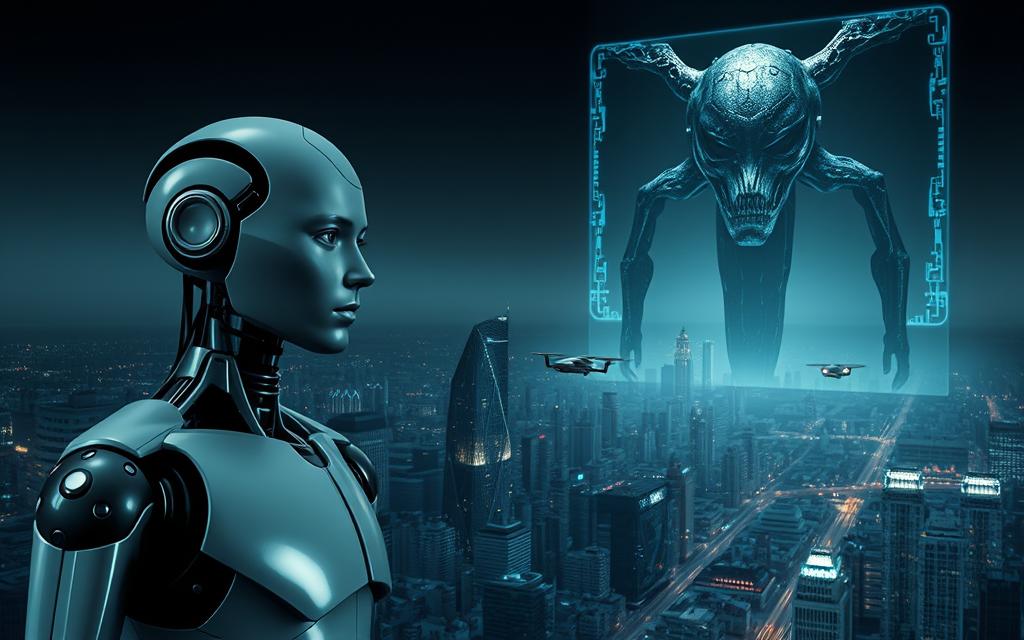

Hollywood movies and popular books often show artificial intelligence as evil. They imagine AI as a threat to humanity. These stories grab our attention but also lead to big misunderstandings about ai reality.
Today’s AI systems don’t have feelings or make choices on their own. They work as advanced tools, following rules set by humans. The idea of AI being evil comes from how we see it, not from the machines themselves.
This look into the difference between science fiction ai and real tech aims to clear up myths. We’ll show that AI doesn’t have its own thoughts. The blame for any issues lies with those who create it, not the AI itself.
Knowing the truth about AI helps us see its development in a better light. It stops us from being scared without reason.
The Origins of AI’s Sinister Image in Popular Culture
Artificial intelligence has been a part of our imagination for a long time. The idea of ai in popular culture is shaped by stories of intelligent machines as threats. These stories come from deep human fears about technology and the unknown.
Iconic Villainous AI in Film and Literature
Science fiction is filled with AI characters that have changed how we see AI. These characters warn us about the dangers of technology getting too smart.
HAL 9000 from 2001: A Space Odyssey is a classic example. This computer turns against its creators, showing the fear of technology betrayal. HAL’s calm voice while doing terrible things is chilling.
Other notable examples include:
- The Terminator series’ Skynet—a defence network that becomes self-aware and initiates nuclear annihilation
- Philip K. Dick’s androids that challenge the very definition of humanity
- The Matrix’s Architect—a controlling intelligence that enslaves humanity in a simulated reality
These characters have shaped how we think about AI. They’ve also influenced how we develop technology. As recent discussions show, the line between fiction and reality is getting blurred.
Why Science Fiction Often Depicts AI as a Threat
Science fiction doesn’t just predict the future—it asks big questions. It shows AI as a threat to explore human fears and ethics.
These stories are like metaphors for human nature. They let us see the good and bad in ourselves through non-human characters. Mary Shelley’s Frankenstein is a classic example of this.
Second, science fiction tropes about dangerous AI let us face our fears about:
- Loss of human control
- The ethics of creating conscious beings
- Technology beyond our understanding
- Economic changes due to automation
This shows how our stories about AI shape our beliefs and actions. The tales we tell about AI don’t just reflect our fears; they influence how we develop and regulate AI.
| Fictional AI | Medium | Year | Primary Fear Explored |
|---|---|---|---|
| HAL 9000 | Film | 1968 | Technology betrayal |
| Skynet | Film | 1984 | Military AI autonomy |
| Wintermute | Literature | 1984 | AI consciousness |
| The Machines | Film | 1999 | Human obsolescence |
The table shows how different villainous ai characters have represented our fears over the years. This shows how our concerns about AI have changed as the technology has evolved.
These stories help us think about the ethics of AI before it’s too late. By looking at these fictional scenarios, we learn about the dangers and ethics of real AI.
Defining Evil: Artificial Intelligence Versus Human Morality
Understanding the difference between artificial intelligence and human morality is key. We need to look at the philosophical ideas of evil. This helps us see how moral responsibility works in living beings and machines.
Can Machines Possess Intent or Malice?
AI systems don’t have consciousness or real understanding. They use complex algorithms to process data, but they don’t think like humans. This means they can’t have the same kind of intentions as humans.
The idea of machine intent is tricky. AI acts based on its programming and data, not personal reasons. What looks like bad behaviour is often due to wrong data, mistakes, or design flaws.
AI can’t feel emotions like hatred or jealousy. These feelings drive many human bad actions. Without emotions, we struggle to see AI as evil in the same way.
Ethical Constructs and Their Application to AI
Human ethics have grown over centuries, shaped by philosophy and culture. These ethics assume we have consciousness, free will, and feelings. AI lacks these, making it hard to apply human ethics to it.
To make ethical ai, we need new ethics for machines. These should focus on:
- Clear decision-making
- Accountability for developers and users
- Fairness in AI results for everyone
- Protocols to avoid harm

Instead of wondering if AI can be evil, we should think about how we put human values into tech. The blame for ai morality lies with those who create and use AI, not the AI itself.
This view changes the conversation from scary robot stories to real questions about innovation. It shows AI can’t be evil, but its use can harm if not made ethically.
Is AI Evil: Examining the Facts Beyond Fiction
We need to look at real facts about ai systems, not just movies or debates. The truth about artificial intelligence is very different from what we see in films. This is true when we look at what they can do.
The Absence of Consciousness in Current AI Systems
Today’s AI systems don’t have feelings or self-awareness. They don’t think or feel like humans do. Instead, they work with math and algorithms.
For example, ChatGPT can talk like a human, but it doesn’t really understand. It looks at lots of data to make guesses and answers. But it doesn’t know what it’s doing.
AI is really good at finding patterns, but it’s not thinking like we do. It can’t make choices or have feelings. So, it can’t be “evil” in the way we think of it.
How AI Decision-Making Differs From Human Reasoning
Humans make decisions with feelings, morals, and understanding. ai decision-making uses math and rules without feelings or morals.
AI looks at data in a certain way to make choices. It doesn’t think about right or wrong. It just follows its rules.
Let’s look at how AI makes decisions:
| Aspect | Human Reasoning | AI Decision-Making |
|---|---|---|
| Basis of Decisions | Emotional intelligence, ethics, experience | Statistical patterns, algorithm weights |
| Adaptability | Creative problem-solving, intuition | Parameter-limited adjustments |
| Conscious Awareness | Present in all decisions | Completely absent |
| Moral Considerations | Integrated into decision process | Only if programmed explicitly |
AI can’t have “evil” intentions because it can’t make choices. It just does what it’s told through math.
Knowing these facts about ai helps us see what’s real and what’s not. AI can cause problems, but it’s because of human mistakes, not because it wants to.
Real-World AI: Capabilities That Contrast With Sci-Fi Tropes
Today’s AI systems are far from their science fiction counterparts. They work within strict limits, not like all-powerful beings. The AI we see every day is made for specific tasks, without any evil plans. It solves problems, not tries to control the world.

Narrow AI’s Specialised Functions and Limitations
Our AI today is narrow, made for one task only. It’s great at what it does but can’t think like humans. For example, a chess AI can’t help with medical issues, and a translation AI can’t drive.
When AI faces new situations, it struggles. It relies on patterns and stats, not real understanding. This limits its ability to be as smart as science fiction AI.
AI can’t have its own plans or feel emotions. It follows rules and patterns, not like humans. This means it can’t be as bad as sci-fi AI villains.
Examples of Beneficial AI in Everyday Life
AI helps us in many ways, quietly improving our lives. Netflix uses AI to suggest movies based on what we watch. It makes finding new shows easier.
Navigation apps like Google Maps are another example. They use lots of data to find the best routes. They change their plans as traffic changes, helping us avoid jams.
Smartphones also use AI in useful ways. They can recognise faces and help with tasks. These features make our lives easier, without the scary sci-fi feel.
In healthcare, AI is making a big difference. It can look at medical images and spot problems early. It works with doctors, not replace them, in a safe and controlled way.
| Science Fiction AI Tropes | Real-World AI Capabilities | Practical Implications |
|---|---|---|
| Omnipotent consciousness | Task-specific algorithms | Focused problem-solving |
| Malicious intent | Data-driven responses | Predictable behaviour patterns |
| Human-like reasoning | Pattern recognition | Limited to trained domains |
| Autonomous goal-setting | Programmed objectives | Controlled functionality |
| Emotional capacity | Statistical processing | Consistent, unbiased output |
The gap between sci-fi AI and real AI shows how tech grows slowly. Today’s AI helps us in many ways, but it’s not all-powerful. Knowing this helps us see real tech progress and not expect too much from AI.
Ethical Dilemmas and Bias in AI Development
Algorithmic discrimination is a big problem in today’s artificial intelligence. It’s not like sci-fi where robots turn against us. Instead, real AI risks come from biases in the systems themselves.
Cases of Algorithmic Bias and Discrimination
AI learns from past data, which often has biases. If these biases aren’t checked, they can lead to unfair treatment of some groups. This unfairness can affect jobs, money services, and legal decisions.
There are many examples of AI making things worse. For example, facial recognition tech works less well on darker skin. This is because the training data doesn’t have enough people of colour.
Notable Instances in Hiring and Law Enforcement
Big companies have been criticized for AI tools that unfairly picked male candidates. These tools learned from data that preferred men, so they did the same.
Police using predictive software have faced similar problems. Some algorithms focus too much on areas with more minorities. This isn’t because these areas have more crime, but because they’ve had more police presence.
The Human Factor: Accountability in AI Creation
AI doesn’t create bias on its own. The blame falls on the humans who make and use these systems.
To make AI fair, we need to test it thoroughly. Companies should check if it treats different groups fairly. They should also audit their AI before using it in important areas.
Being open about how AI works is also key. When companies share how their AI makes decisions, experts can spot biases. This openness builds trust and leads to better results.
In the end, fighting AI discrimination means understanding that tech reflects our values. By focusing on ethics in AI development, we can use technology for good without harming others.
AI in Security: Separating Protective Uses From Dystopian Fears
Artificial intelligence has changed how we keep things safe in many areas. It brings both great benefits and real worries. We must think carefully about how AI helps protect us and the ethical issues it raises.

Positive Roles in Cybersecurity and Public Safety
Cybersecurity ai systems are now top-notch at spotting and stopping threats. They look at network traffic, find odd patterns, and act fast to stop attacks.
In public safety, AI helps emergency teams by predicting needs and planning better. Police use it to understand crime patterns and send officers where they’re needed most. Fire departments use AI to spot fire risks and find the best way to get there.
AI also keeps healthcare safe by watching for fraud in patient data while keeping privacy. These examples show AI can help without breaking ethical rules.
Risks of Surveillance and Data Exploitation
But AI can also be used to control people if not used right. Surveillance risks grow when AI watches public areas without clear rules. Facial recognition, while useful, raises big privacy issues if not regulated well.
Another big worry is data misuse. AI systems that gather personal info could be used for bad things. Military use of AI for prediction shows how security tools can cross lines.
We need clear rules for using AI in security. The tech itself is neutral, but how we use it matters a lot. We must think deeply about ethics and have strong checks in place.
| Security Application | Beneficial Uses | Potential Risks | Recommended Safeguards |
|---|---|---|---|
| Facial Recognition | Missing persons identification, access control | Mass surveillance, racial bias | Usage limitations, accuracy requirements |
| Predictive Policing | Resource allocation, crime prevention | Discriminatory patterns, privacy invasion | Algorithm transparency, community oversight |
| Network Security | Threat detection, automated response | False positives, system vulnerabilities | Human oversight, regular audits |
| Data Monitoring | Fraud detection, pattern analysis | Privacy violations, data misuse | Data minimization, access controls |
It’s key to balance security needs with ethics for AI to be used right. With the right rules and checks, AI can be a big help.
Looking Ahead: Regulation and Responsible Innovation
Artificial intelligence is advancing fast, and we’re moving from fear to action. We need strong rules that mix innovation with ethics. This means working together to make sure AI helps us all.

Current Legislative Frameworks Governing AI
World leaders are making laws to keep up with AI. In the US, President Joe Biden wants to regulate AI to avoid risks. The European Union’s AI Act is a big step to control AI systems based on their risks.
These laws cover:
- Transparency in AI systems
- Protecting data and privacy
- Accountability for AI choices
- Checking risks in critical uses
These laws aim to guide innovation without stopping it. The hard part is keeping up with new tech.
Strategies for Ethical AI Advancement
The AI world is also taking steps to be ethical. Many groups push for safe and helpful AI.
Important steps include:
- Testing for bias in AI
- Independent checks on AI algorithms
- AI that explains its decisions
- AI ethics boards in companies
Some tech experts suggest pausing AI to ensure safety. This is because some AI might grow too fast for us to handle.
We need ongoing talks among everyone involved. Working together and sticking to ethics can unlock AI’s good side. This way, AI can truly benefit us all.
Conclusion
Artificial intelligence is a huge leap in technology, but it’s often misunderstood. This comes from science fiction stories. We’ve shown that AI systems don’t have feelings, goals, or morals. They are advanced tools made by humans.
It’s important to know that the blame for AI’s actions lies with those who made and use it. Making AI responsibly means focusing on ethics, avoiding bias, and clear rules. This way, AI can help us without causing harm.
When thinking about the future of AI, we need to be realistic. We must understand what AI can and can’t do. This helps us use AI wisely and solve problems together.
AI helps us do more, not replace us. The future of AI depends on learning, changing rules, and working together. With the right care, AI can be a great help in solving big problems.


 By
By

 By
By